What is crypto arbitrage?
Why does crypto arbitrage occur? Copy link
To understand how crypto arbitrage works and how you can profit from it, let's first look at the concept of arbitrage itself and understand why the same cryptocurrency can have different prices on different platforms.
In traditional financial markets, arbitrage is the practice of taking advantage of price differences for the same or related asset across different markets. The cryptocurrency market is particularly interesting from an arbitrage perspective because it consists of many independent trading platforms, with no single central authority setting the price.
Where cryptocurrencies are traded
Today, you can buy and sell cryptocurrencies on a wide range of different platforms. Depending on how the market is structured, how trading is conducted, and how prices are determined, these can include:
- Centralized cryptocurrency exchanges (CEX) - Binance, Bybit, OKX, MEXC, Bitget, Gate, KuCoin, BingX, HTX, and dozens of others. On these exchanges, users place orders in the order book, and the price is determined by current supply and demand. A CEX is a platform where the exchange itself controls all user operations and holds users' funds in its own cryptocurrency wallets.
- Decentralized exchanges (DEX) - for example, Uniswap, PancakeSwap, Hyperliquid, Aster, and others. Trading on these platforms takes place using blockchain technology and smart contracts, and the price formation mechanism may differ from a traditional exchange order book. Assets are exchanged directly between users' wallets without an intermediary in the form of a single company. These exchanges do not require KYC verification.
- Cryptocurrency exchange services - services that allow users to exchange one cryptocurrency for another, as well as cryptocurrency for fiat currency and vice versa. An exchange can take place online, with assets sent to the exchange service from an exchange account or wallet and assets received from the exchange service into an exchange account or wallet, or offline by visiting the exchange service's physical office. When using exchange services, it is important to consider the service's reputation and exchange terms. To find and compare offers, we recommend using the trusted BestChange exchange service aggregator.
- Other trading platforms and markets - cryptocurrency derivatives, perpetual futures, delivery futures, and other financial instruments can also create price discrepancies that are used in various arbitrage strategies.
Thus, the cryptocurrency market is not a single platform with one fixed price for each asset. There are many exchanges, markets, and trading instruments operating simultaneously, and each may have its own prices.
Why does the same cryptocurrency have different prices on different exchanges?
At first glance, it may seem that if Bitcoin or another popular cryptocurrency has a market price, it should cost exactly the same on every exchange. In practice, this is not the case.
Each cryptocurrency exchange is a separate market with its own participants and infrastructure. Each platform has different buyers and sellers, different orders are placed, and trading volumes and liquidity can vary significantly.
Each exchange has its own:
- order book - a list of current buy and sell orders
- market participants - traders, investors, arbitrage traders, and market makers
- trading volume - the amount of buying and selling over a given period
- liquidity - the number of available orders near the current market price
- fees for trading, deposits, and withdrawals
- trading restrictions and minimum order sizes
- market makers who provide liquidity for specific trading pairs
- balance of supply and demand
- order processing speed and trading infrastructure characteristics
- availability of specific trading pairs and markets
As a result, the price of Bitcoin, Ethereum, or any other cryptocurrency can differ slightly across cryptocurrency exchanges at the same moment.
For example, let's take a look at CoinMarketCap and compare the price at which Bitcoin is trading on different cryptocurrency exchanges.
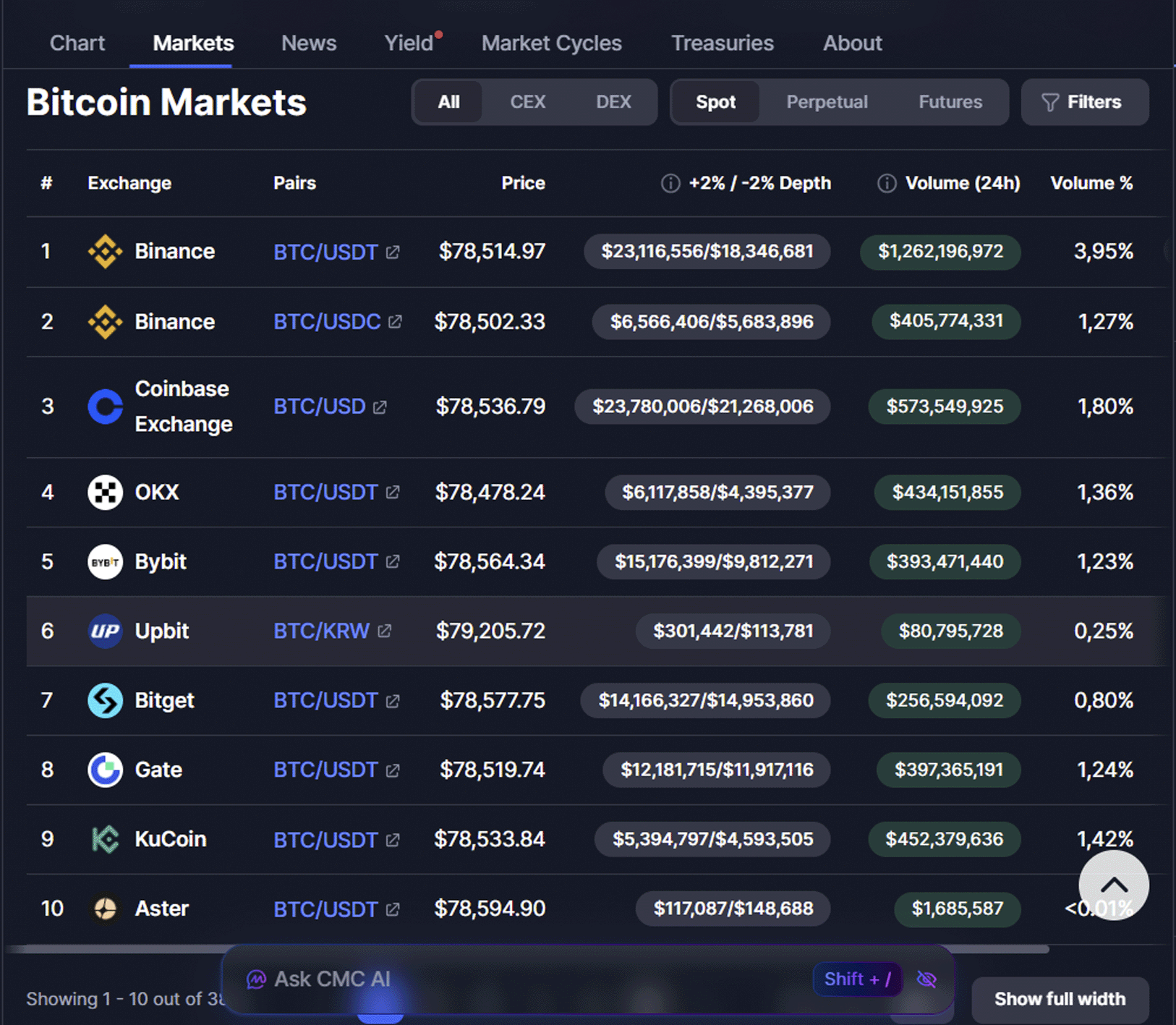
As you can see, there are many exchanges, and the price can vary between them.
For example, at a given moment, the best sell order for Bitcoin on one exchange may be at $100,000, while on another it may be at $100,300. That's a $300 difference per BTC.
These price discrepancies are exactly what create opportunities for cryptocurrency arbitrage.
Why do prices usually converge?
If an asset is significantly cheaper on one exchange than on another, market participants are incentivized to buy it where the price is lower and sell it where the price is higher.
Let's assume that Bitcoin is trading at $100,000 on exchange A and $100,500 on exchange B.
A trader can buy BTC on exchange A and simultaneously sell BTC on exchange B. If this operation is possible and a positive price difference remains after accounting for all costs, the trader can earn a potential arbitrage profit.
At the same time, the actions of other market participants begin to affect the prices themselves:
- additional buying on the cheaper exchange increases demand
- additional selling on the more expensive exchange increases supply
- the price difference gradually decreases
As a result, prices across different platforms may converge again.
The tendency of price discrepancies to narrow is one of the key ideas behind arbitrage trading.
However, it is important to understand that prices do not have to become identical instantly. The price difference may persist for some time, increase, or disappear within a fraction of a second.
Why do arbitrage opportunities arise?
- First, cryptocurrency trading on most platforms takes place 24 hours a day, 7 days a week. Unlike traditional stock exchanges, the crypto market does not close at night, on weekends, or on holidays.
- Second, there are many cryptocurrency exchanges, each with its own user base, liquidity, and trading infrastructure.
- Third, new tokens and trading pairs are constantly being introduced to the market. Some of them have significantly different liquidity across exchanges, so price discrepancies can be much larger than for highly liquid assets.
- Fourth, cryptocurrencies are traded across several types of markets. The same asset can have a spot price, a perpetual futures price, and prices for other derivatives. This creates additional opportunities for different types of arbitrage.
- Finally, the cryptocurrency market operates in conditions of high volatility. During sharp price movements, the load on exchanges increases, orders in order books are executed and repriced rapidly, and price differences between platforms can temporarily become more pronounced.
Therefore, crypto arbitrage can exist even when thousands of traders and automated trading systems are simultaneously tracking the price of the same asset.
What is crypto arbitrage? Copy link
Crypto arbitrage involves taking advantage of price differences for the same asset across different platforms. In very simple terms, a trader can buy Bitcoin on one exchange at a lower price and then sell it on another exchange at a higher price.
Crypto arbitrage is a strategy in which a trader profits from price differences between the same or related crypto assets across different exchanges, markets, or trading instruments.
In the simplest terms: Buy where it's cheaper → sell where it's more expensive → keep the difference.
But in reality, arbitrage is much broader than simply buying on one exchange and selling on another. There are different types of arbitrage, and profitability depends on fees, execution speed, liquidity, funding rates, withdrawals, and many other factors, depending on the type of arbitrage.
The simplest example of calculating arbitrage profit looks like this:
Let's assume that Bitcoin is currently priced at:
- On Binance - $100,000
- On Bybit - $100,300
The reason for the price difference can be quite ordinary: there are currently more sellers on Binance and more buyers on Bybit. As a result, the best available prices in the order books of these exchanges are different.
In theory, you could:
- Buy BTC on Binance for $100,000
- Transfer BTC to Bybit
- Sell BTC on Bybit for $100,300
- Difference - $300
If the operations are performed simultaneously, this is arbitrage.
But $300 is not net profit.
You need to subtract:
- Binance spot trading fee
- Bybit spot trading fee
- slippage if the trader buys the coin at market price
- the cost of transferring the coin between exchanges
Therefore, the actual profit could be, for example, not $300 but $180, or it could even be negative.
How is crypto arbitrage different from regular cryptocurrency trading? Copy link
Arbitrage is fundamentally different from regular trading because the trader does not necessarily try to predict the direction of the market.
A regular trader might think: BTC is currently trading at $100,000. I think it will rise to $105,000, so I'll buy it. In this case, the trader is trying to predict the direction of the asset's price and can either make or lose money. If BTC falls to $95,000, the trader loses money. If BTC rises to $105,000, the trader makes a profit.
An arbitrage trader, on the other hand, builds a setup in which future changes in the overall price of the asset have minimal impact on the result. The profit comes specifically from the price difference that exists at a particular moment in time. This setup is called an arbitrage opportunity.
Arbitrage is not limited to two exchanges
It is important to note that crypto arbitrage is not limited to simply "buying Bitcoin on one exchange and selling it on another."
There are various types of arbitrage strategies. For example:
- arbitrage between two centralized exchanges;
- spot-futures arbitrage;
- funding rate arbitrage;
- futures price spread arbitrage;
- CEX-DEX arbitrage;
- triangular arbitrage within a single exchange;
- arbitrage through cryptocurrency exchange services;
- cross-exchange arbitrage across different trading pairs.
The principle remains similar: the trader tries to open interconnected positions simultaneously in a way that generates profit from the relative price difference rather than from predicting the future direction of the overall market.