What is spread in crypto arbitrage?
In crypto arbitrage, the spread is the difference between the prices of the same asset across different exchanges, markets, or trading instruments. This price discrepancy is the basis of many arbitrage strategies: a trader buys the asset where it is cheaper and simultaneously sells it where it is more expensive.
For example, the same coin is priced at $100 on Binance and $101 on Bybit.
The price difference is $1.
To express this difference as a percentage, you can use the following formula:
Spread = (Selling Price − Buying Price) / Buying Price × 100%
In our example: ($101 − $100) / $100 × 100% = 1%.
So, the spread between the exchanges is 1%.
However, real-world crypto arbitrage is somewhat more complicated. The spread itself does not mean that a trader is guaranteed to earn 1%. To evaluate the actual arbitrage opportunity, you need to account for fees, liquidity, slippage, trade size, and other costs.
Spread is not net profit Copy link
This is one of the most important concepts for beginners in crypto arbitrage.
Depending on the specific strategy, the following costs may need to be deducted from the potential spread:
- buying fee
- selling fee
- withdrawal fee
- slippage
- other costs
For example, let's say the spread between two exchanges is 1%.
If the total trading fees are 0.2%, the remaining spread after fees is approximately:
1% − 0.2% = 0.8%.
How is the spread calculated? Copy link
Different cryptocurrency arbitrage scanners may use different methods to calculate the spread.
1 Cryptocurrency arbitrage scanner between exchanges
For example, in our cryptocurrency arbitrage scanner between exchanges https://t.me/BigBTC_arbitrage_bot, you can enable the option to include trading fees in the calculations in the settings.
In addition, the spread calculation takes the order book into account based on the starting amount entered by the user.
This means that the scanner does not simply compare two displayed prices. Instead, it considers how much of the trade can actually be executed using the available orders in the order book for the selected amount.
Therefore, the displayed spread may differ from the simple difference between the two best available prices.
2 Cryptocurrency futures arbitrage scanner
Our funding rate and futures price spread arbitrage scanner https://t.me/BigBTC_funding_bot uses several spread calculations. We will explain them in more detail in other educational materials. For now, let's take a look at the different types of spread calculations.
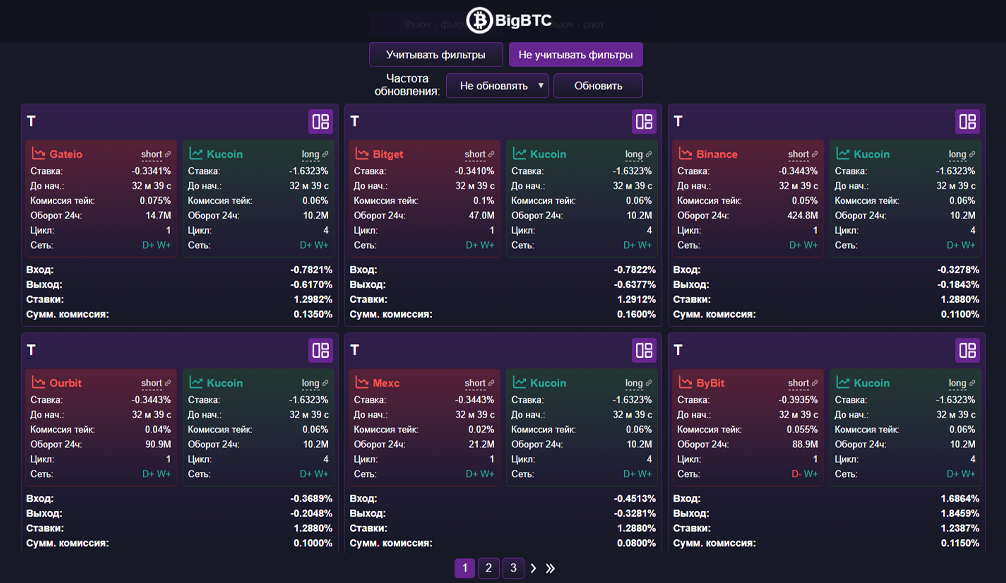
Here we can see three types of spread:
- Entry spread - the price spread when entering a trade. It shows the profit the trader would enter the trade with at that moment.
- Exit spread - the price spread when exiting a trade. It shows the result the trader would get if they exited the trade at that moment. However, this parameter is specifically relevant when exiting a trade; when entering, it is only an additional analytical metric.
- Funding rate spread - the difference between the funding rates on two different exchanges.