What is an arbitrage opportunity in crypto?
In crypto arbitrage, an arbitrage opportunity is a specific combination of trading operations, platforms, and parameters that shows how to take advantage of an existing price difference and potentially earn a profit.
In the simplest terms, an arbitrage opportunity answers several questions:
What to buy → where to buy → what to sell → where to sell → at what price → what spread will result → how much can be earned after fees.
This is why the term "arbitrage opportunity" is often used by arbitrage traders to refer to a specific opportunity to execute an arbitrage trade.
For example, it is not enough to say: "BTC has different prices on different exchanges." This only indicates that a price discrepancy exists.
A crypto arbitrage opportunity is much more specific: Buy BTC on Binance at $100,000 → simultaneously sell BTC on Bybit at $100,300 → spread of 0.3%.
This combination already represents a specific arbitrage opportunity.
What an arbitrage opportunity consists of Copy link
The components of an arbitrage opportunity may vary depending on the strategy and type of arbitrage. However, it usually includes several key parameters.
1 Cryptocurrency or trading asset
The first thing to determine is which asset is involved in the arbitrage operation. It can be practically any cryptocurrency that is traded on multiple platforms.
However, it is important to consider not only the name of the coin but also the specific trading instrument.
For example, BTC can be traded simultaneously:
- on the BTC/USDT spot market
- on a BTCUSDT perpetual futures contract
- on another futures contract
- on a DEX
- in different trading pairs
Therefore, two operations involving BTC are not necessarily the same arbitrage opportunity.
2 Buying platform
The next parameter is the platform where the asset can be bought at a lower price.
This can be a centralized cryptocurrency exchange, decentralized exchange, cryptocurrency exchange service, or another trading platform.
3 Selling platform
The other side of the arbitrage opportunity is the platform where the same asset can be sold at a higher price.
Thus, the simplest cross-exchange arbitrage opportunity looks like this:
Binance → buy → BTC → Bybit → sell.
The difference between the buying and selling prices creates potential arbitrage profit.
4 Buying and selling prices
An arbitrage opportunity must include the specific buying and selling prices.
5 Spread
One of the key indicators of an arbitrage opportunity is the spread - the percentage difference between the buying and selling prices.
For example:
buying price - $100,000
selling price - $100,300
The spread is approximately 0.3%.
The spread is often used to quickly identify potentially profitable arbitrage opportunities.
The larger the spread, the higher the potential profit before expenses.
Professional analysis of an arbitrage opportunity is not limited to the spread alone.
6 Fees
When calculating an arbitrage opportunity, you need to account for fees associated with executing the trades.
If a trader buys an asset on one exchange and sells it on another, there are usually at least two trading fees:
- buying fee
- selling fee
For example, if the total spread is 0.5% and the total trading fees are 0.2%, the potential difference is already reduced to 0.3%.
In addition to trading fees, there may be other costs depending on the type of arbitrage:
- cryptocurrency withdrawal fee
- deposit fee
- network fee
- conversion fee, and so on
For example, take a look at this arbitrage opportunity from our cryptocurrency arbitrage bot for the exchange-to-exchange service direction with exchange services listed on the BestChange aggregator https://t.me/arbitrage_mexc_bot :
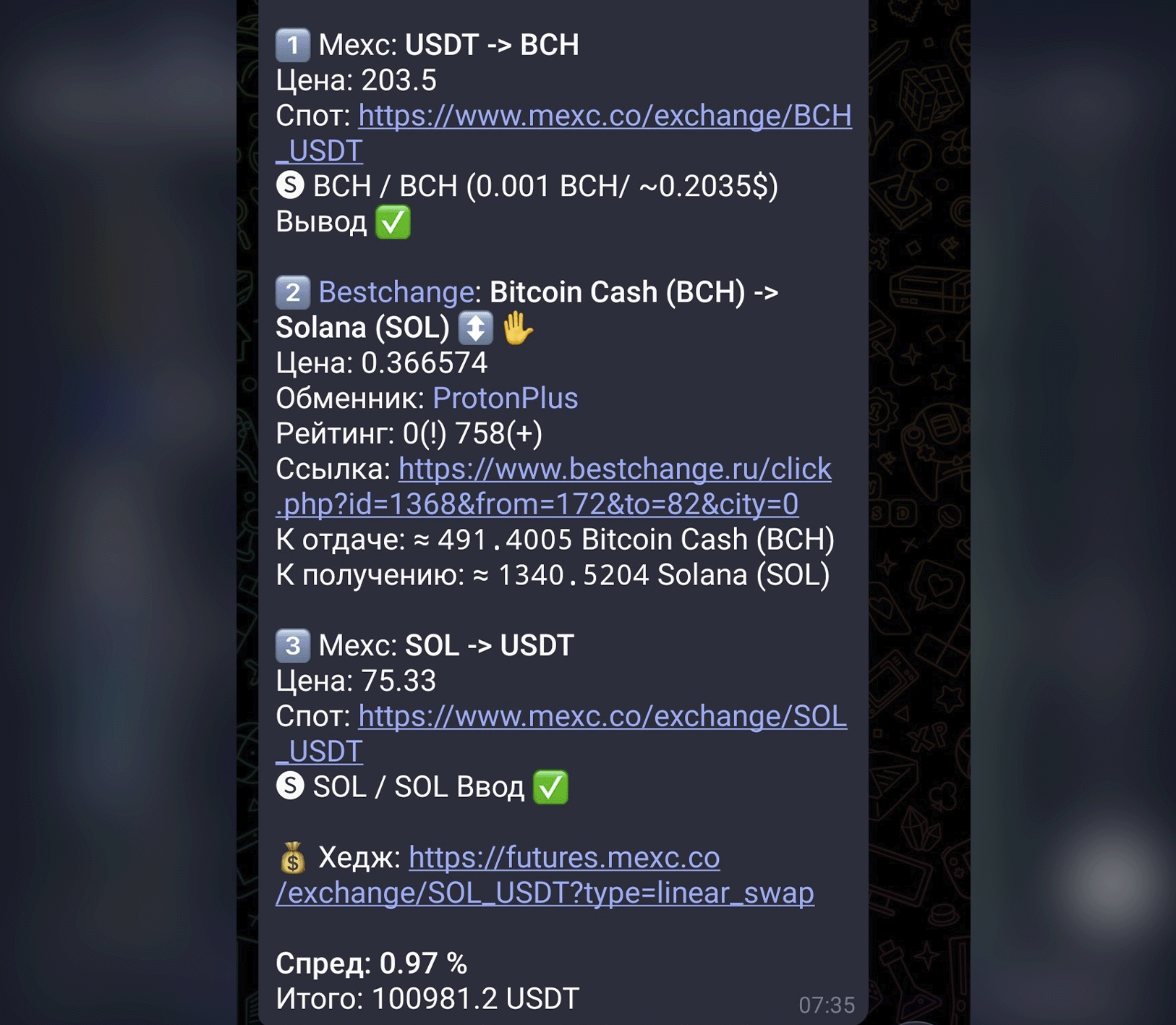
Here, BCH needs to be withdrawn to the exchange service's account using its native BCH network. The withdrawal fee is $0.2035, and this fee is already included in the spread.
Therefore, when searching for arbitrage opportunities, it is important to look at potential net profit, not just the spread.
7 Other parameters
If the arbitrage opportunity involves transferring cryptocurrency between platforms, you need to consider the blockchain network being used.
For example, USDT may be supported on several different networks:
- Ethereum (ERC-20)
- Tron (TRC-20)
- BNB Chain
- Solana
- Arbitrum
- and others
Transfer costs, speed, and availability may vary.
Moreover, one exchange may support a particular network for a specific coin while another may not. Therefore, it is also important to check whether the same networks are available on both platforms for the specific coin. Otherwise, the trader simply won't be able to transfer the coin from one exchange to another.
For example, let's look at this arbitrage opportunity from our cryptocurrency arbitrage bot between exchanges https://t.me/BigBTC_arbitrage_bot :
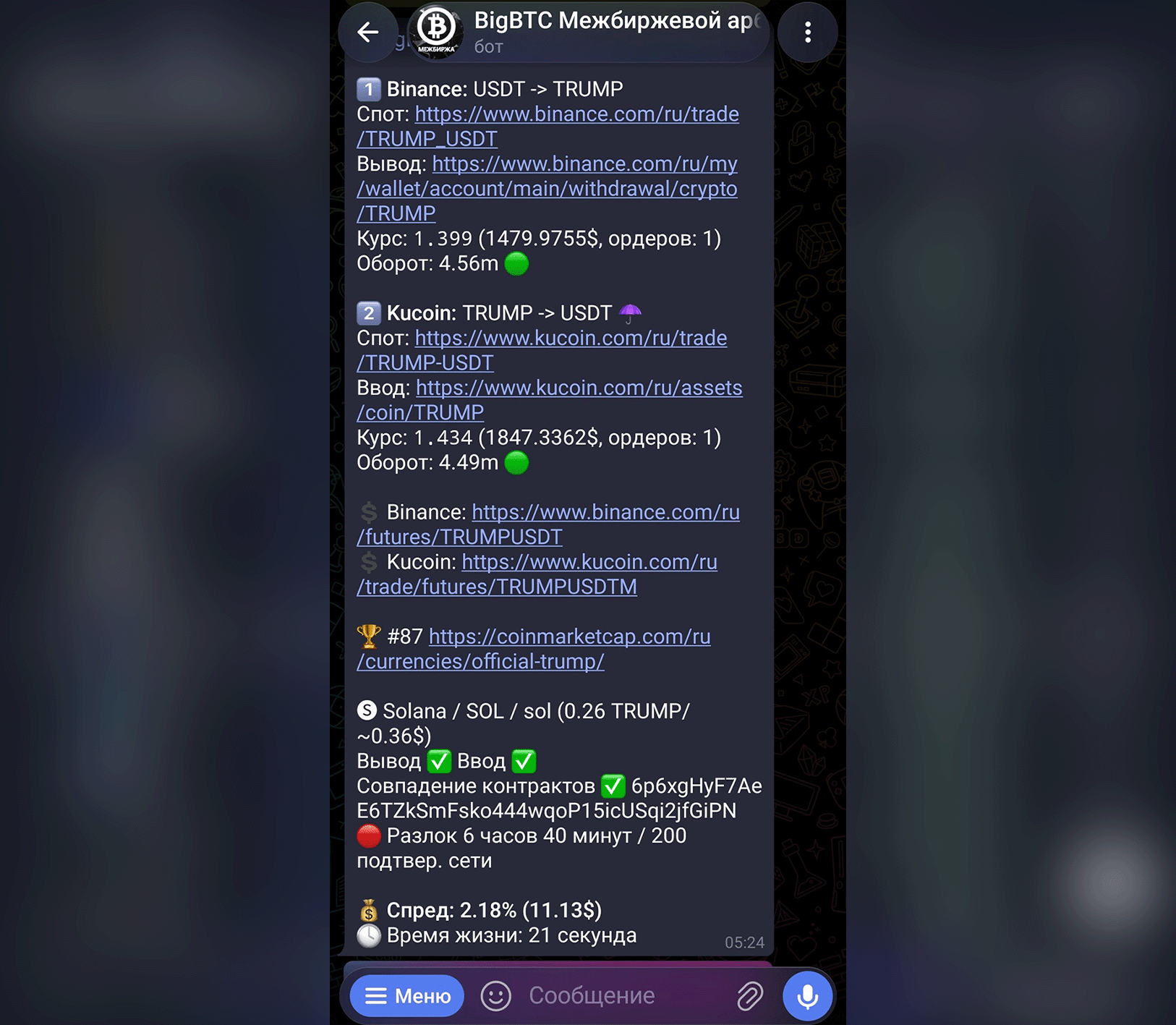
Here we can see that TRUMP can be transferred between the exchanges using the Solana network. The transfer fee is $0.36, and we can also see how long the transfer will take.
Another important parameter is the trading volume that can actually be executed.
Suppose an arbitrage opportunity shows a 1% spread, but only $50 worth of cryptocurrency can be bought at the favorable price. For a large trader, this opportunity is practically useless.
Another arbitrage opportunity may have a spread of just 0.3% but allow a trade of $100,000.
Potential profit is usually calculated based on the volume that can actually be executed at the quoted prices.
In the same example, the trader entered a starting amount of $1,000 in the scanner settings. The scanner checked the order book and found that TRUMP could be bought and sold on both exchanges using just one order from the order book.
Or here is another example from the same scanner https://t.me/BigBTC_arbitrage_bot :
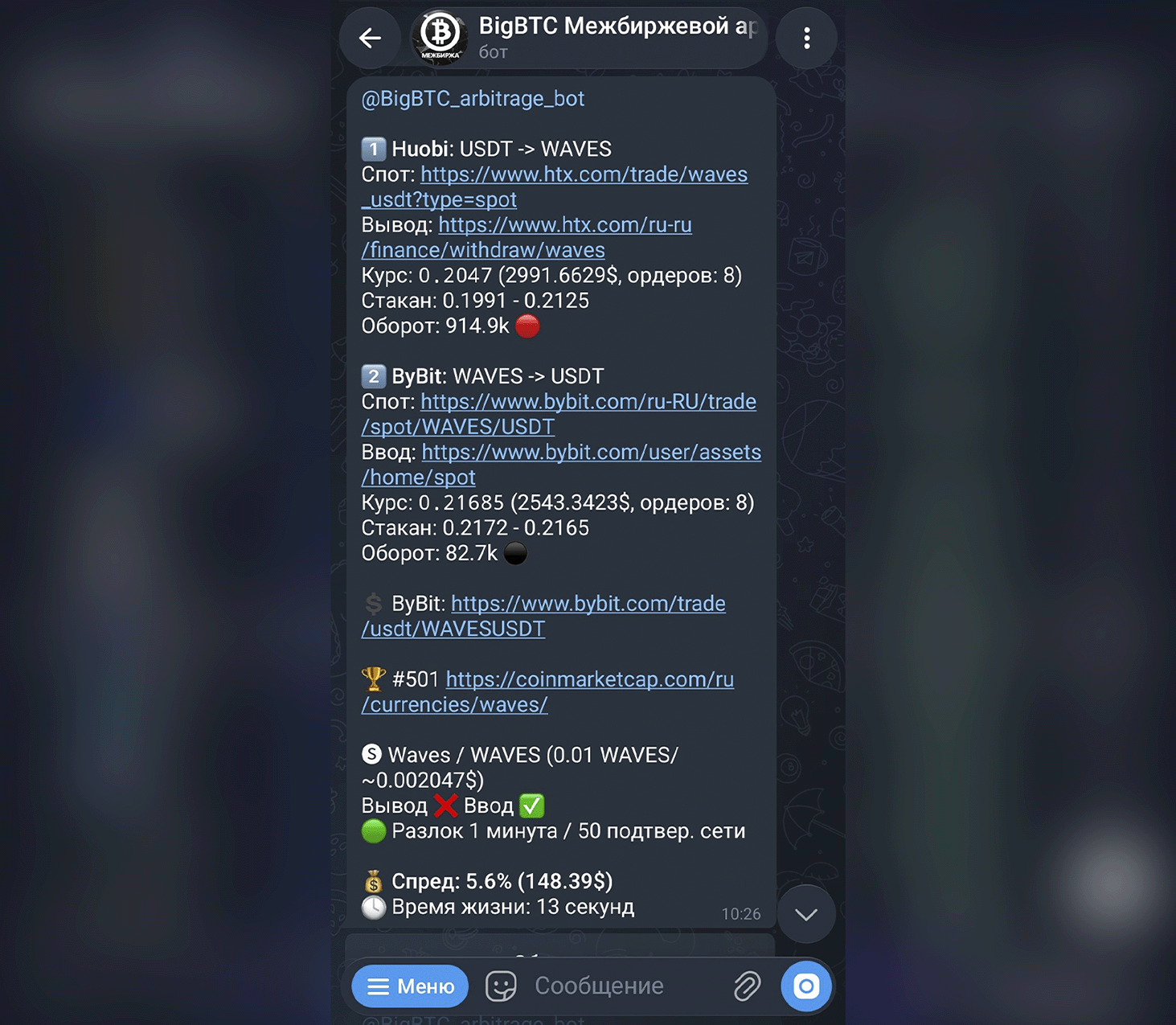
The trader specified in the scanner settings that they are working with an amount of $2,000.
The scanner checked the order book and found that the trader would need to execute 8 orders from the order book on both exchanges.
In this case, the coin's price for the trader will not be equal to the price of the first order in the order book. The trader needs to account for all 8 orders. The spread will also be calculated based on the orders that are actually executed.
There are many other parameters that are needed to analyze arbitrage opportunities. They vary depending on the type of arbitrage, so we will cover them when discussing specific types of arbitrage.
Why arbitrage opportunities constantly change Copy link
Cryptocurrency prices do not stay still.
On every exchange, the following are constantly changing:
- new buy orders
- new sell orders
- order cancellations
- the appearance of large orders
- liquidity
- trading volume
- the price of the underlying asset
Therefore, an arbitrage opportunity that was available a few seconds ago can disappear almost instantly or remain available for some time.
Let's take another look at the arbitrage opportunity:
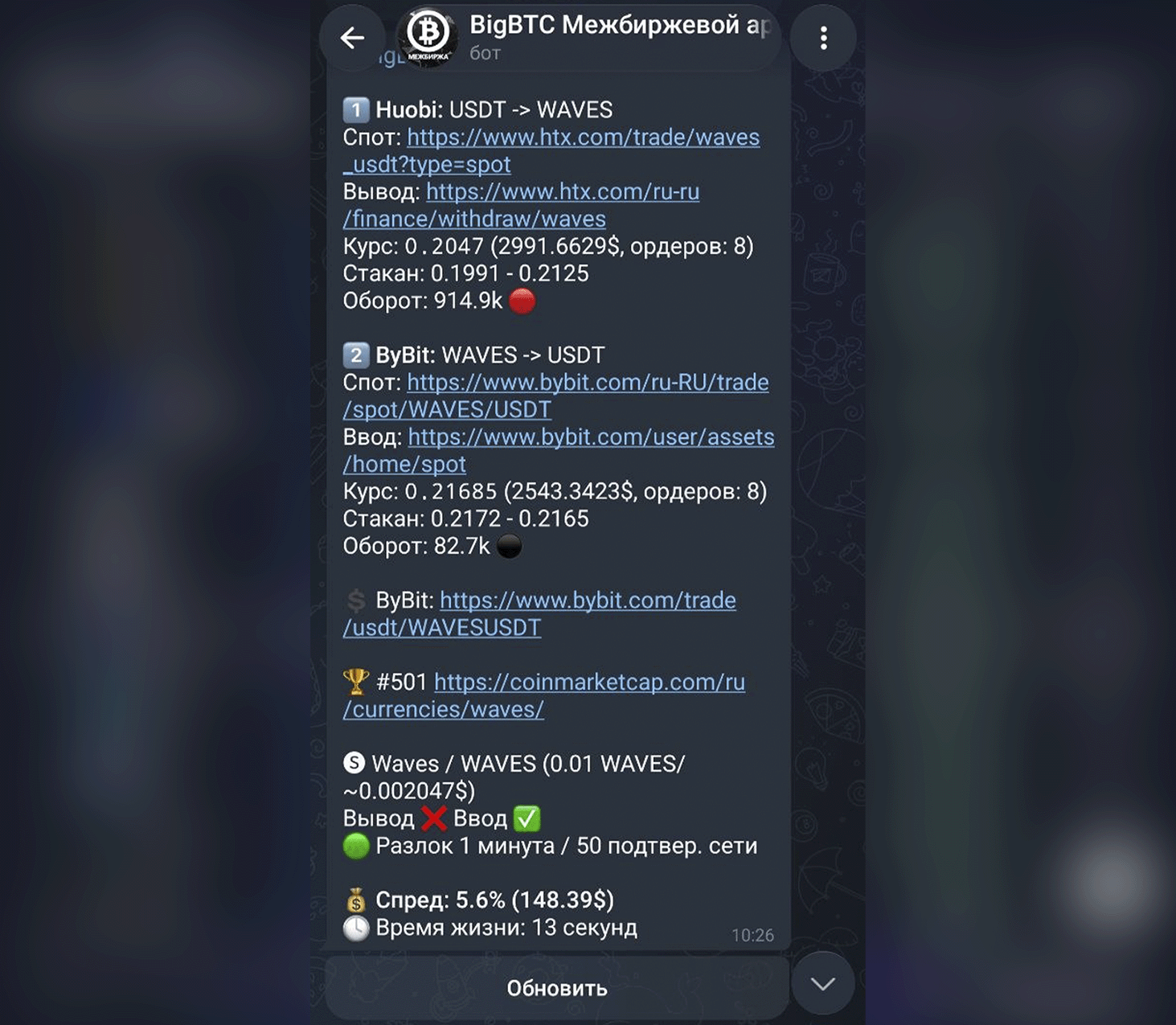
In this arbitrage opportunity, we can see that its lifetime is 13 seconds. This means that the spread for this opportunity has remained positive for 13 seconds.
We can also see a REFRESH button below the arbitrage opportunity. Clicking this button refreshes the opportunity, and the scanner recalculates the spread based on the latest coin prices.
Therefore, the speed of receiving market data and the speed of analysis are extremely important for arbitrage trading.
How an arbitrage opportunity differs from a signal Copy link
When discussing cryptocurrency arbitrage, the terms "arbitrage opportunity" and "signal" are sometimes used as synonyms. However, this is not entirely correct. They describe different things.
An arbitrage opportunity is a specific trading setup that shows where and how to execute an arbitrage trade.
A signal is a message or notification that tells a trader that a specific trading opportunity has appeared at that moment.
In simple terms:
- An arbitrage opportunity is the trading setup itself. It contains the specific parameters of the arbitrage trade and describes which operations need to be executed and between which platforms the price discrepancy exists.
- A signal is a message telling the trader that the opportunity is worth paying attention to. The signal itself is not a separate type of arbitrage trade.
In the context of an arbitrage scanner, the term "arbitrage opportunity" more accurately describes the result of the system's work.
The word "signal" is widely used in trading and usually refers to a trading recommendation or notification. For example: "BTC buy signal."
In this case, the signal may suggest that BTC should be bought because its price is expected to rise.
In arbitrage, the situation is fundamentally different.
An arbitrage trader does not necessarily need a forecast that Bitcoin will rise, for example. It may be enough to see that BTC is currently cheaper on one platform and more expensive on another.
Therefore, an arbitrage opportunity is not necessarily a buy or sell signal in the traditional technical analysis sense.
Instead, it represents a relative price opportunity between two interconnected trades.