What is a crypto exchange order book and how to read it
A crypto exchange order book is a list of current buy and sell orders placed by market participants at specific prices. The order book shows how much traders are willing to buy or sell and at what price.
An order book is constantly updated: new orders appear, existing orders are modified or canceled, and filled orders disappear. Therefore, it shows the current state of supply and demand for a specific trading pair.
For a crypto trader, an order book is useful not only for placing orders. It can also be used to assess liquidity, spread, market depth, potential slippage, and the concentration of orders at specific price levels.
For cryptocurrency arbitrage, the order book is especially important: it helps determine the actual price at which you can buy or sell a given amount of coins and whether there is enough liquidity to execute the trade.
What is an order book on a crypto exchange in simple terms? Copy link
Imagine that thousands of people simultaneously want to buy or sell BTC.
Ready to buy:
| Buyer | BTC they are willing to buy | Price |
|---|---|---|
| #1 | 1 BTC | $100,000 |
| #2 | 2 BTC | $99,950 |
| #3 | 5 BTC | $99,900 |
On the other side are the sellers:
| Seller | BTC they are willing to sell | Price |
|---|---|---|
| №1 | 1 BTC | $100 050 |
| №2 | 3 BTC | $100 100 |
| №3 | 5 BTC | $100 2000 |
All of these active orders make up the order book.
It can be roughly represented as follows:
| 🔴 | $100 200 | 5 BTC |
| 🔴 | $100 100 | 3 BTC |
| 🔴 | $100 050 | 1 BTC |
| $100 025 | Last price | |
| 🟢 | $100 000 | 1 BTC |
| 🟢 | $99 950 | 2 BTC |
| 🟢 | $99 900 | 5 BTC |
At the top 🔴 are the sellers' orders, and at the bottom 🟢 are the buyers' orders.
It is important to understand that the order book does not show all possible trades, but only current active orders waiting to be filled.
When an order is filled or canceled, it is either updated or removed from the order book. This is why a crypto order book is constantly changing.
How does a crypto exchange order book work? Copy link
What are Bid and Ask? The best price.
Every order book consists of at least two main parts:
1 Asks - sell orders
Ask - the price at which a seller is willing to sell an asset.
In the table above, they are marked in red 🔴, and on exchanges they are also usually displayed in red.
The lower the sell price, the closer the order is to the center of the order book.
The lowest Ask is the best available sell order.
2 Bids - buy orders
Bid - the price at which a buyer is willing to purchase an asset.
In the table above, they are marked in green 🟢, and on exchanges they are also usually displayed in green.
The higher the buy price, the closer the order is to the center of the order book.
The highest Bid is the best available buy order.
A real exchange order book looks like this (example from Binance). Asks are at the top, while bids are in the lower section.
At the top, there are three columns:
- Price (USDT) - the price of the order
- Amount (BTC) - the amount of BTC at this price level
- Total - the value of the amount in USDT. The "Total" column here shows the value of the amount at a specific price level, not the cumulative volume of the entire order book.
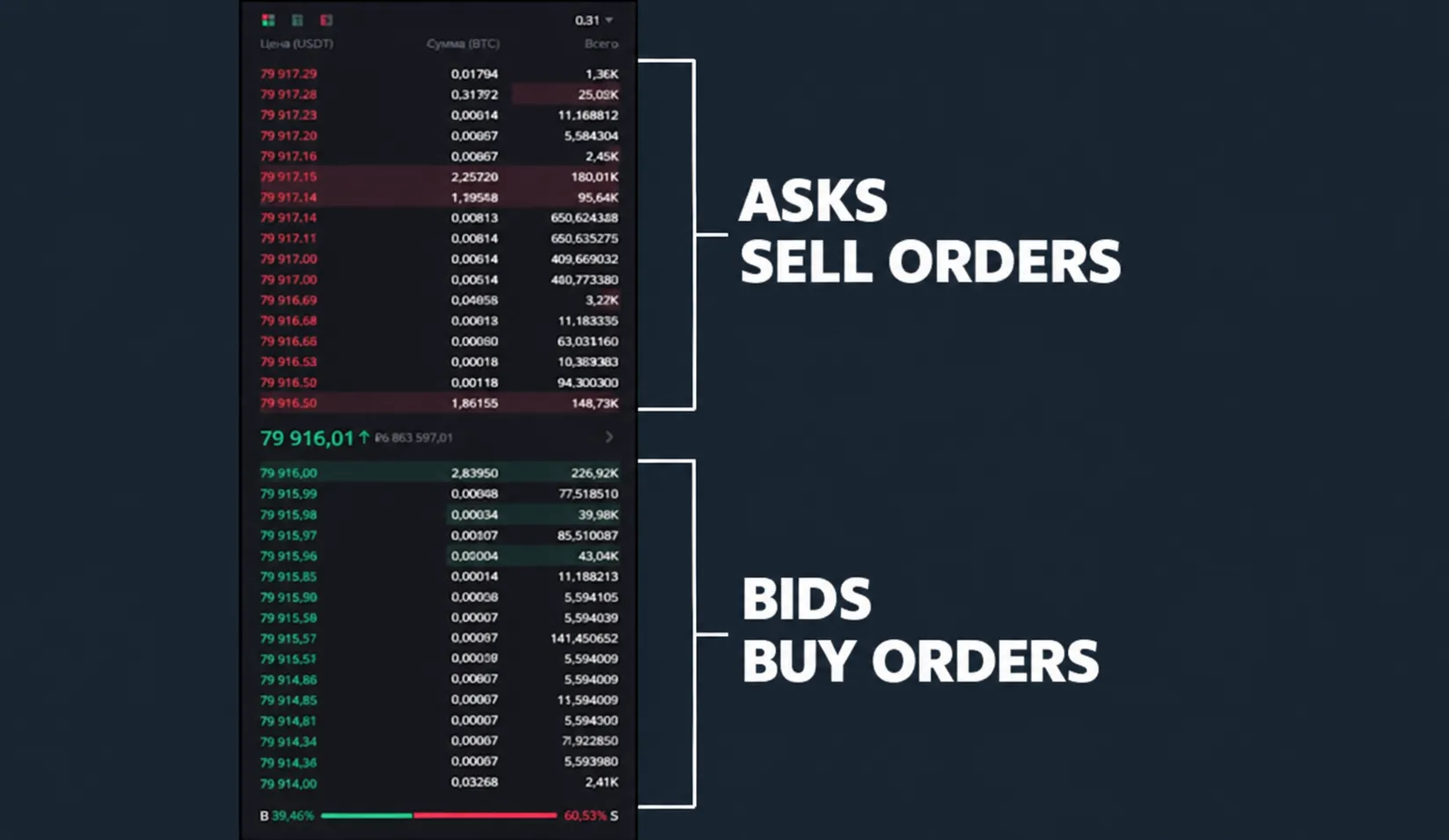
Asks are at the top. They show orders from users who want to sell BTC at the specified price.
Ask prices are arranged from higher to lower, with the most favorable selling price for the buyer — the best Ask — closest to the center of the order book.
The best Ask is the lowest price at which there is currently an offer to sell BTC in the order book.
In other words, if someone submits a sufficiently large market order to buy BTC, execution will start at this price level.
The lower green section is the Bid side.
Bid orders are orders from users who want to buy BTC at the specified price.
For Bids, the order is reversed: the highest buy price is shown first, followed by progressively lower prices.
The first green row, the first Bid, is the best Bid — the highest price that someone is currently willing to pay for BTC.
Which orders are visible in the order book? Limit and market orders.
When placing a limit order, a trader specifies the price at which they are willing to buy or sell an asset. The limit order remains in the order book until it is filled by a matching order or canceled by the trader.
A market order is not displayed in the order book as a pending order. It is executed immediately at the available prices on the opposite side of the order book.
The main difference between a limit order and a market order is that limit orders are executed at the specified price, while market orders are executed immediately at the current available prices.
The order book is primarily made up of limit orders.
Visualizing liquidity size in the order book
Let's take another look at the screenshot of the exchange order book:
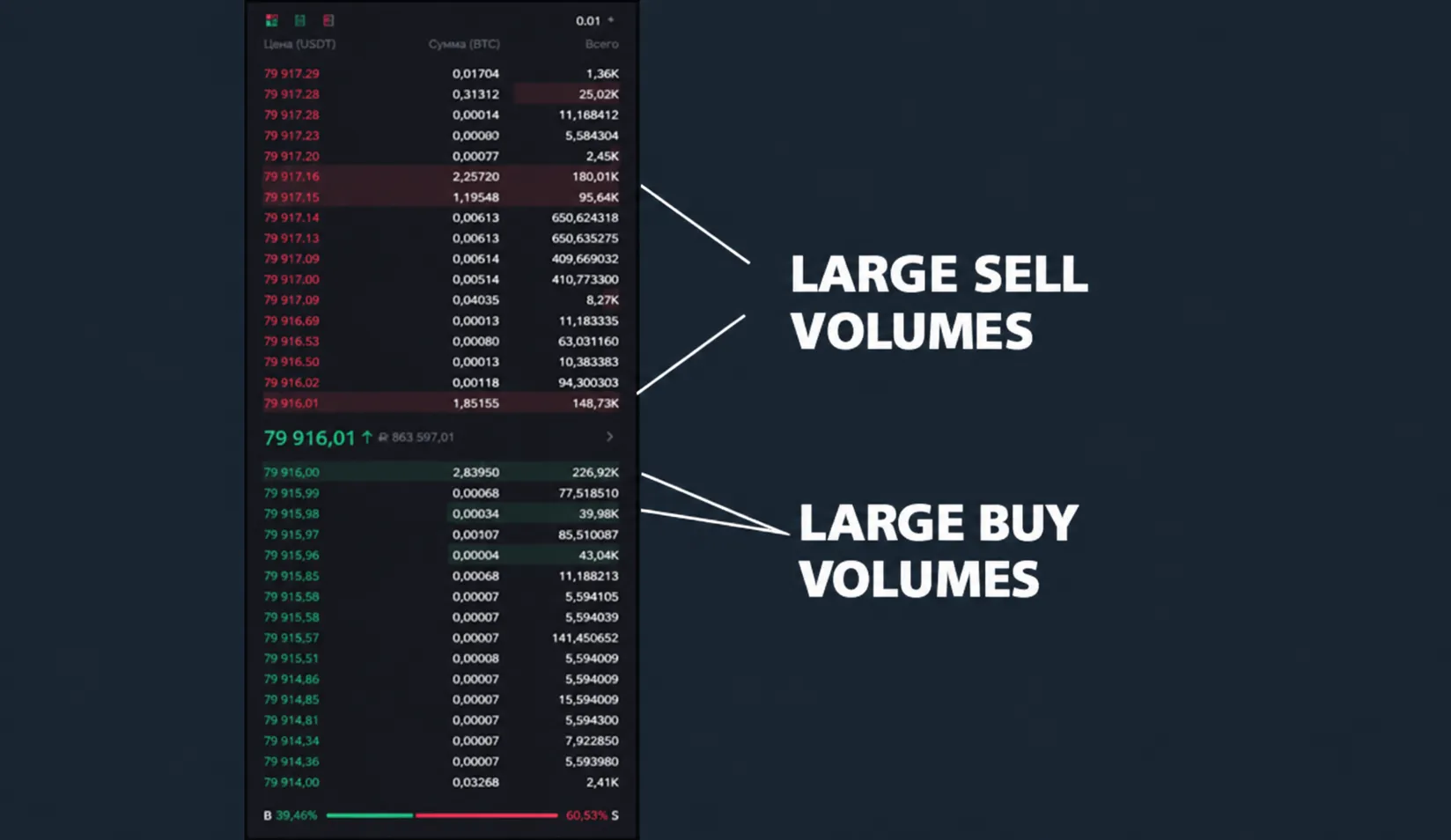
Here we can see that large orders in the order book are highlighted in red and green. Some rows in the order book have a more noticeable background.
This is a visualization of liquidity size at specific price levels.
The larger the volume at a price level, the more prominently the row is usually highlighted.
This allows you to quickly see where large concentrations of orders are located in the order book.
Order book depth
Order book depth (Market Depth) shows how many orders are available at different price levels and how far these levels extend from the current price.
A deep order book contains large buy and sell volumes distributed across many price levels.
In a shallow (thin) order book, price levels quickly disappear.
The more liquidity there is near the current price, the deeper the market.
| Deep order book | Shallow order book |
|---|---|
| High liquidity | Low liquidity |
| Many orders | Few orders |
| Lower slippage | High slippage; large orders move the order book |
| Lower risk of manipulation | Higher risk of manipulation - the price is easier to move |
| Narrow Bid-Ask Spread | Wide Bid-Ask Spread |
Current price and visual indicator of the latest price change
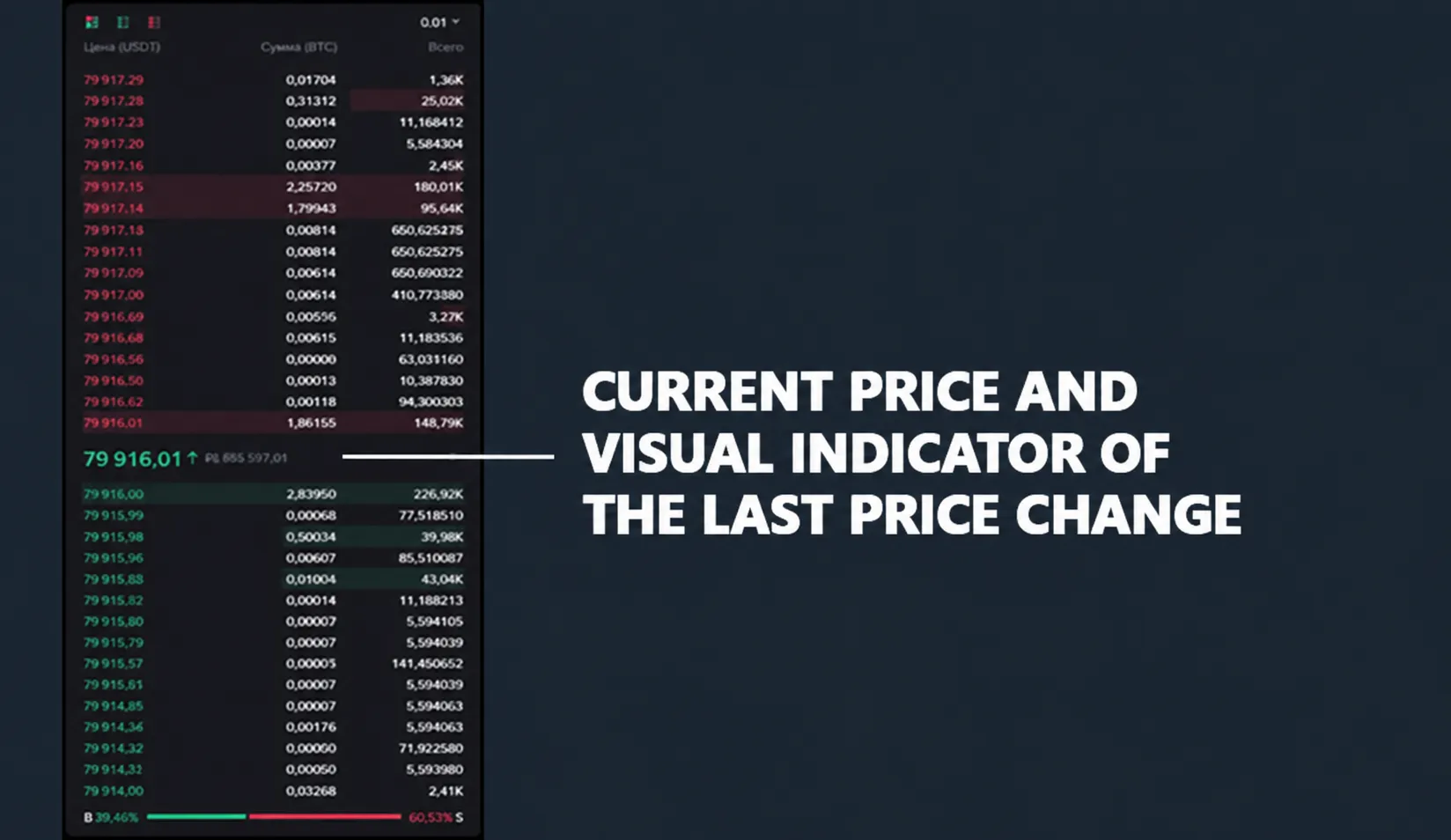
In the middle of the order book, we can see the price of 79,916.01.
This is the current displayed BTC price.
At the same time, there is an important detail to note:
last price = 79,916.01
best Ask = 79,916.01
best Bid = 79,916.00
This means the last trade occurred at 79,916.01, which also coincides with the best Ask at the moment the screenshot was taken.
The order book is constantly updating, so these values could have already changed a fraction of a second later.
The green arrow next to the price shows the direction of the latest price change — in this case, the last traded price moved up. This is a visual indicator of the latest price change.
Balance between buyers and sellers
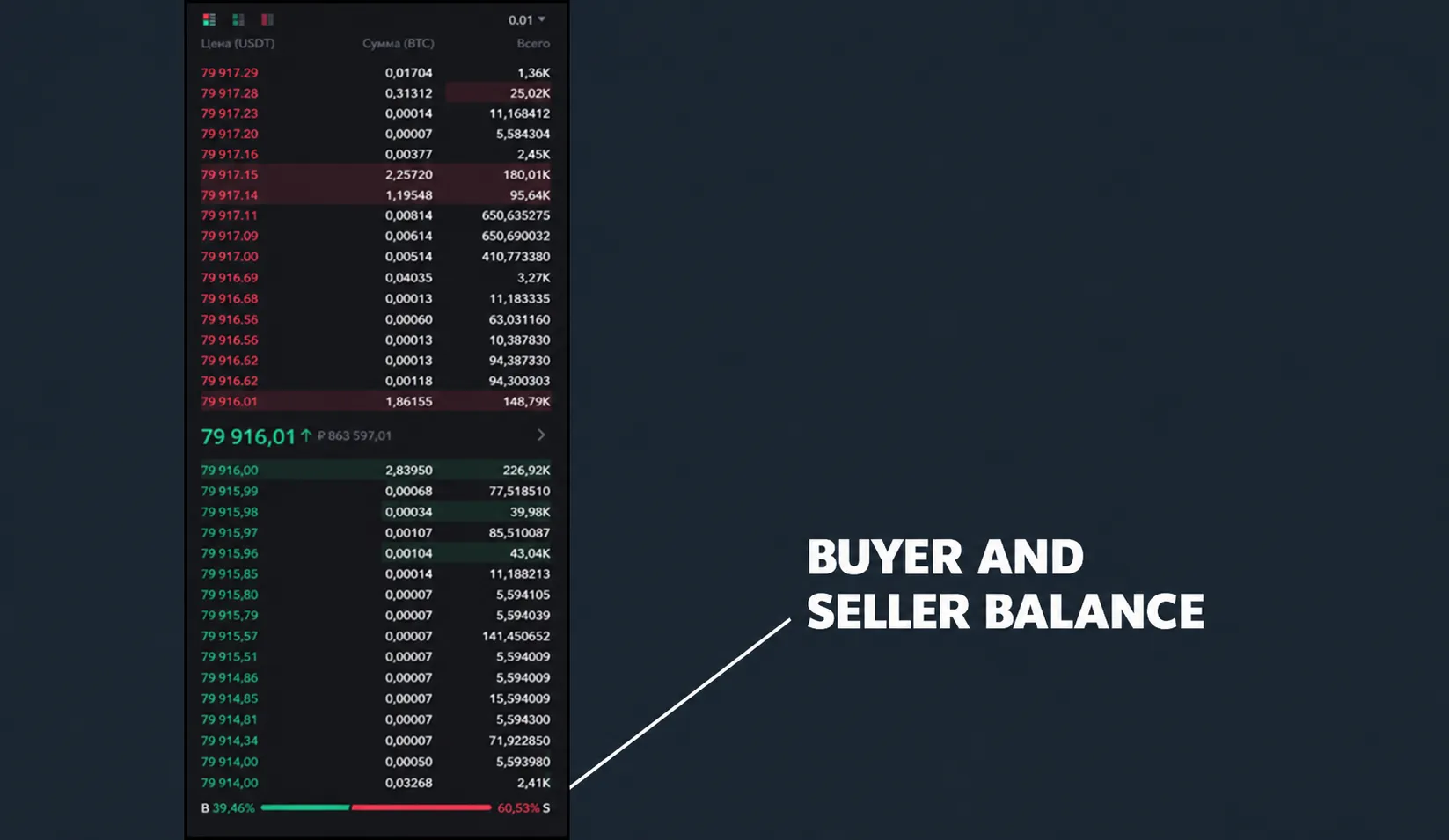
The balance between buyers and sellers is the ratio of the displayed buy-side and sell-side liquidity in the order book.
Buy orders (B) are shown in green, while sell orders (S) are shown in red. This is the percentage ratio of buy and sell volumes across the top levels of the order book.
Why is an exchange order book needed? Copy link
1 Assessing liquidity
The order book shows how much volume is available near the current price.
This is especially important before executing a large trade.
2 Assessing the spread
The order book allows you to immediately see:
- the best buy price
- the best sell price
- the difference between them
For active trading, a narrow spread is generally preferable to a wide spread.
3 Assessing slippage
Before placing a large order, you can check how much volume is available at the nearest price levels. If there are not enough orders, the trade may be executed across multiple prices. This is called slippage.
4 Finding large concentrations of liquidity
The order book can show price levels where large volumes of orders are concentrated.
Don't focus only on a single large order. One large order may look impressive but disappear quickly.
Therefore, it is better to analyze multiple price levels, total volume, liquidity distribution, and how quickly orders appear and disappear.
How to read an exchange order book Copy link
1 Determining the Bid-Ask Spread
The Bid-Ask Spread is the difference between the best buy price and the best sell price.
The spread can be expressed in dollars or as a percentage.
The smaller the spread and the greater the volume of orders around the current price, the more liquid the market usually is.
If you need to quickly buy and then sell a large amount of cryptocurrency, a wide spread increases the cost of entering and exiting the position.
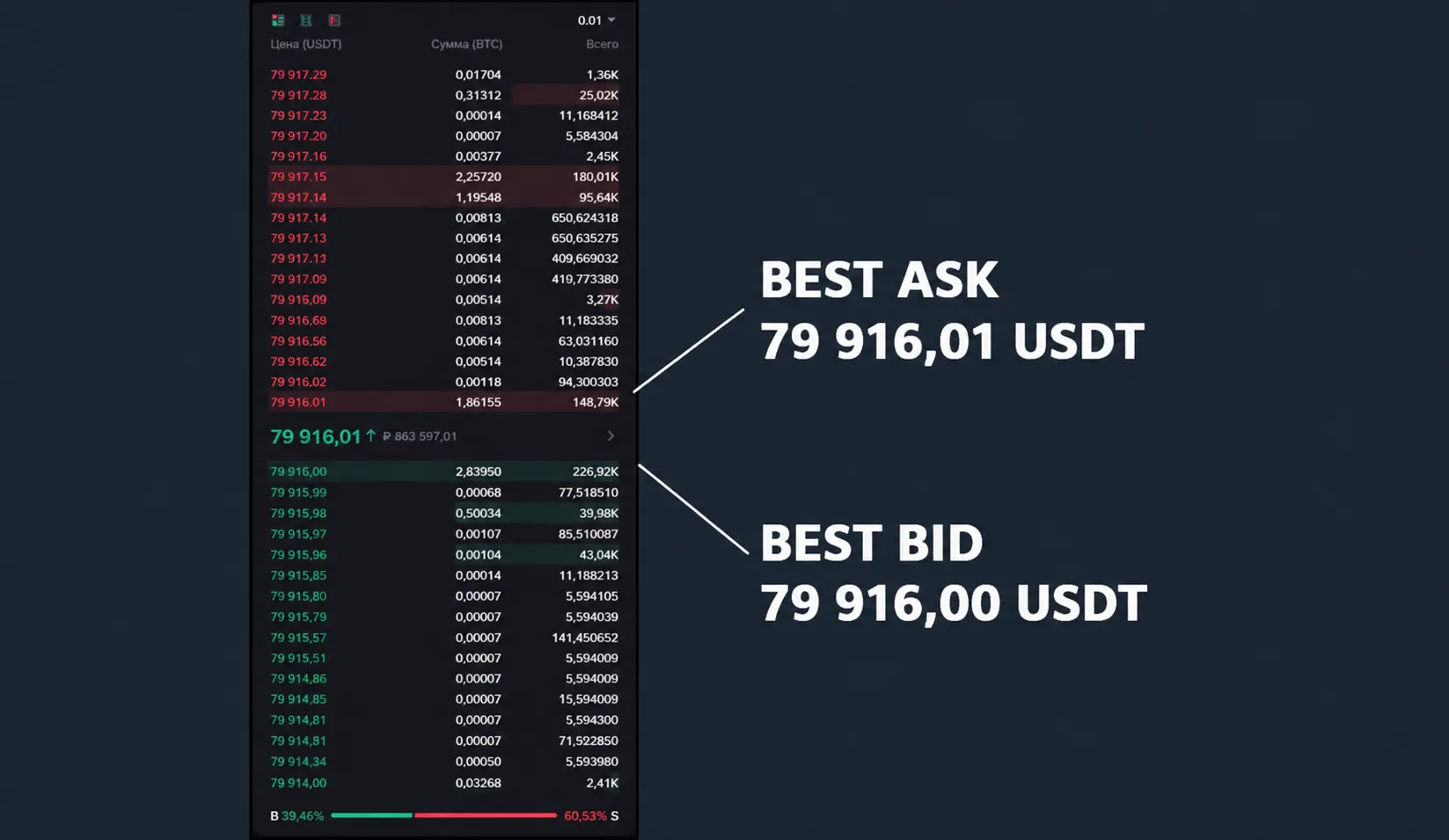
In this case, the Bid-Ask Spread is just 0.01 USDT (79,916.01 − 79,916.00 = 0.01 USDT).
This is typical for a highly liquid BTC/USDT market: the higher the liquidity, the smaller the difference between the best Bid and Ask usually is.
2 Assessing the speed of changes in the order book
The order book is a dynamic tool. Orders can appear, increase, decrease, disappear completely, or be partially filled.
The higher the liquidity, the more actively the order book will usually be updated.
3 Assessing order book depth
The deeper the order book, the better the liquidity.
The size of a trade should be compared with the depth of the order book. For example, the sell side of the order book contains:
$100,100 - 1 BTC
$100,200 - 5 BTC
$100,300 - 10 BTC
$100,400 - 20 BTC
If you only need to buy 0.5 BTC, there is enough liquidity at the first level.
But if you need to buy 30 BTC, a single level is not enough. The market order will be progressively filled at higher prices. The actual purchase price will then be calculated based on multiple order book levels.
If you are planning to make a large trade, don't limit yourself to the first row of the order book. Look at several levels above or below and assess how much volume is available.