Types of cryptocurrency arbitrage
There are different methods and types of cryptocurrency arbitrage. Some have existed and remained popular since the early days of cryptocurrency, while others have appeared only recently. New types of arbitrage continue to emerge, while some strategies have become outdated and are rarely used by arbitrage traders today.
Here are the main types of cryptocurrency arbitrage:
Cross-exchange arbitrage on the spot market of centralized or decentralized exchanges Copy link
This is the most straightforward and popular type of arbitrage. In fact, this is exactly the strategy we discussed in the example above, where Bitcoin was bought on Binance and sold on Bybit.
This strategy is based on taking advantage of short-term price discrepancies between two different exchanges. Arbitrage can be performed between two CEXs, two DEXs, or between a CEX and a DEX.
Price discrepancies between exchanges usually do not last long, so you need to act quickly to take advantage of the market inefficiency before the price corrects. In theory, you can find arbitrage opportunities for this type of arbitrage yourself, but speed is important, so it is more convenient to use specialized scanners that monitor cryptocurrency prices on exchanges in real time and promptly show traders what arbitrage opportunities are currently available. It is important that the scanner accounts for exchange fees, the time required to transfer coins from one exchange to another, whether the coin can currently be transferred between the exchanges, whether the same networks are available for the transfer, and so on. An example of such a scanner is https://t.me/BigBTC_arbitrage_bot
This is what an arbitrage opportunity looks like in cross-exchange arbitrage:
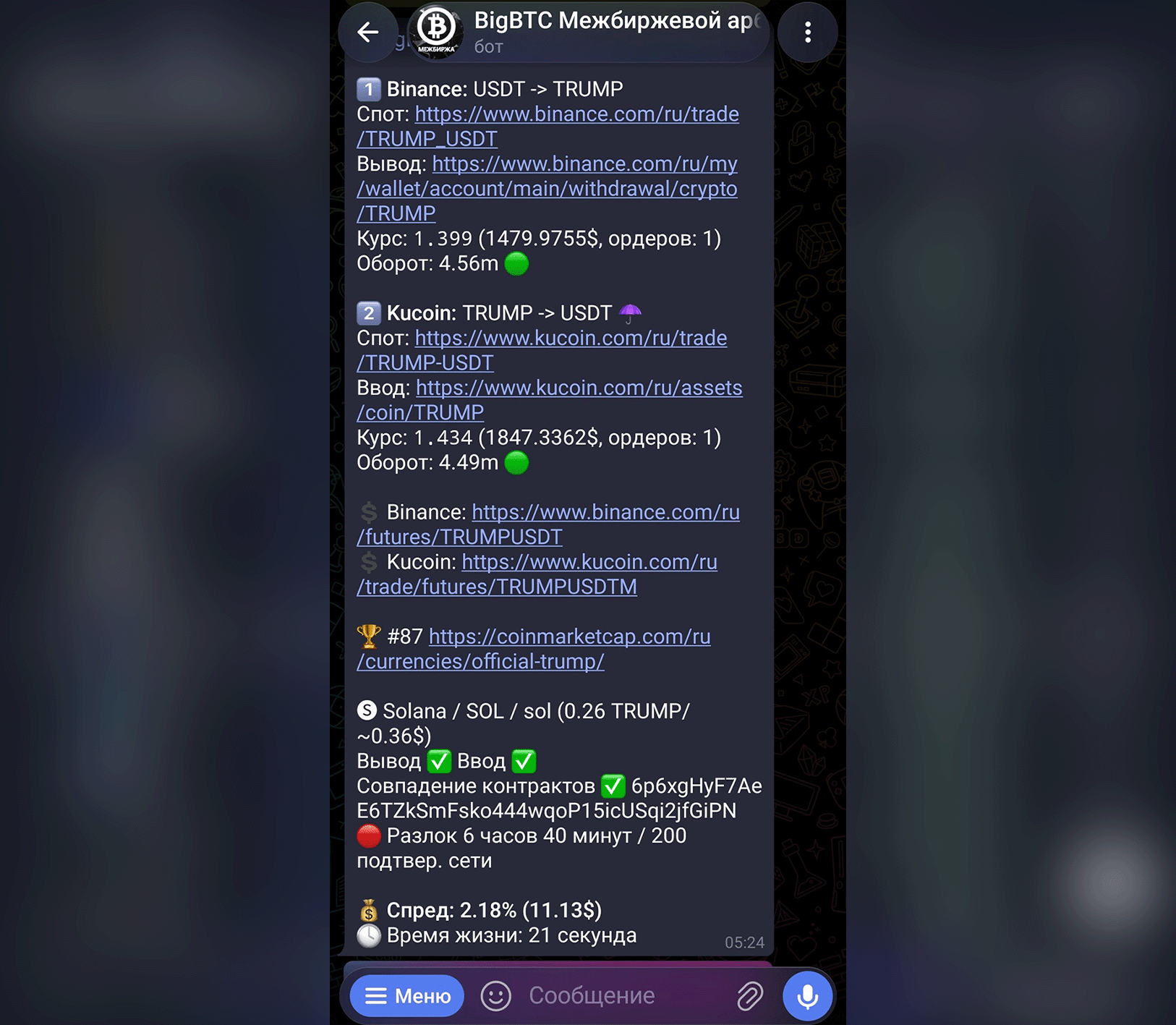
It is important to note that in this type of arbitrage, every opportunity starts and ends with the same predetermined coin. The main idea is that your profit accumulates on the exchanges in this coin. For example, in our scanner, the base coin is a stablecoin. This means that you already have, for example, USDT on the exchange, and after completing the arbitrage opportunity, you end up with your original USDT plus profit in USDT. Bank cards are not involved in these trades. All profit accumulates in stablecoins.
Intra-exchange arbitrage or triangular arbitrage on the spot market Copy link
This type of arbitrage uses three trading pairs on a single exchange. The arbitrage opportunity also starts and ends with the same coin, usually a stablecoin.
For example, suppose we have USDT on Binance. We exchange USDT for BTC, then BTC for ETH, and finally ETH back to USDT — all on the same exchange, Binance. If we end up with more USDT than we had at the beginning, an arbitrage opportunity has occurred.
Why is this type of arbitrage also called "triangular" arbitrage? Because it uses three trading pairs that form a closed cycle: USDT → BTC → ETH → USDT. The key requirement is the same as usual: you must end up with the same currency you started with.
Triangular arbitrage is interesting because it does not require two different exchanges.
However, at this point, we consider this arbitrage strategy practically impossible to execute profitably. Cryptocurrency exchanges have long learned to quickly eliminate such price discrepancies within their own platforms automatically. By the time the first exchange is completed, the price has already stabilized, making it impossible to profit from the second exchange.
Classic P2P arbitrage Copy link
This is a very popular type of arbitrage. It involves working specifically in the P2P section of an exchange. The idea is to buy the same asset from one person on P2P and then sell it to other people on P2P at a slightly higher price.
Here's an example of how it works:
- Place an order to buy cryptocurrency for rubles in the P2P section of an exchange
- After buying the cryptocurrency, place an order to sell the coin in the P2P section of the same exchange at a slightly higher price
- Earn a profit from the price difference in rubles
The risks include:
- Bank card restrictions or blocks. This is currently one of the biggest challenges: banks closely monitor the number and amounts of transfers
- Fraudulent listings
- It is often necessary to use so-called drops - people who provide their exchange accounts and bank cards in exchange for a percentage of the profit. This cannot be considered legitimate activity, and drops can disappear along with your money.
International arbitrage Copy link
International cryptocurrency arbitrage is a type of arbitrage in which a trader takes advantage of price differences for the same cryptocurrency in markets across different countries or regions. This involves using foreign banking systems and currencies to buy and sell cryptocurrency.
The key feature is that the price difference arises not simply between exchanges, but from differences in local supply and demand, exchange rates, liquidity, and trading conditions across different countries.
For example, you can buy USDT for cash in one region, transfer the USDT to a wallet, and then sell it where demand is higher in exchange for cash. An offline exchange is often part of the process, for example through currency exchange services. This can involve cash, physical offices, pre-agreed exchange rates, and large amounts.
The risks and challenges are obvious: high costs, fraud during offline exchanges, physically handling large amounts of cash, and increased banking scrutiny when dealing with cash.
Futures arbitrage Copy link
In general, cryptocurrency futures arbitrage is a strategy for profiting from price differences between the spot and futures markets, or between futures contracts for the same asset on different exchanges. This strategy is typically carried out using perpetual futures.
Important terms:
The spot market is a market where assets are traded at the current market price (spot price) for immediate purchase or sale. On the spot market, traders own the underlying asset.
The futures market is a market where an exchange provides a contract based on the future price of an asset. Here, the trader does not own the underlying asset. Instead, the trader agrees to buy or sell the asset at a specified date for delivery futures (which have an expiration date), or without an expiration date for perpetual futures (perpetuals), at a predetermined price. On the futures market, traders can, but do not have to, use leverage.
Leverage on futures is the ability to open a position larger than the trader's own capital by using funds provided by the exchange. Leverage allows traders to control a larger position with a smaller amount of their own funds.
Margin is the trader's own funds used as collateral for a futures position.
A long position on futures is a bet on the contract price increasing. The trader opens a position expecting the asset to become more valuable.
A short position on futures is a bet on the contract price decreasing. The trader opens a position expecting the asset to become less valuable.
For example:
BTC is trading at $100,000
The trader opens a $1,000 long position, with $200 of margin and 5x leverage (200 × 5 = 1,000)
If BTC rises to $105,000, meaning the price increases by 5%, the trader's profit will be: $1,000 × 5% = $50. The trader earns $50, and their margin increases from $200 to $250. The trader's return on their initial margin (own funds) is 25% ($50 / $200 × 100% = 25%).
If BTC falls to $95,000, meaning the price decreases by 5%, the trader's loss will be: $1,000 × 5% = $50.
Leverage increases the position size relative to the trader's own funds, so profit and loss relative to the margin change much more significantly than the price of the underlying asset itself.
Since perpetual futures have no expiration date, the exchange needs to keep the contract price close to the price of the underlying asset. Otherwise, the price of the same coin on the spot and futures markets could become significantly different. How is this achieved? Exchanges use funding rates to help balance the prices.
Funding, also known as the funding rate, is a mechanism involving periodic payments between traders who hold perpetual futures contracts on exchanges. The main purpose of the funding rate is to keep the price of a perpetual futures contract close to the price of the underlying asset, roughly in line with the spot price.
It is important to understand that the funding rate is not an exchange fee, but rather a payment between traders. The funding payment does not come out of the exchange's pocket.
Funding payments on the perpetual futures market are made at specific intervals. Depending on the exchange, coin, and market conditions, funding may be paid every 1 hour, 4 hours, 8 hours, or at other intervals.
If the funding rate on an exchange is positive, it means the futures price is above the spot price. To bring the prices back in line, the exchange incentivizes traders to open short positions, helping push the futures price down toward the spot price. With a positive funding rate, longs pay shorts.
If the funding rate is negative, it means the futures price is below the spot price. To bring the prices back in line, the exchange incentivizes traders to open long positions. With a negative funding rate, shorts pay longs.
Positive funding → longs pay shorts
Negative funding → shorts pay longs
There are several different arbitrage sub-strategies here, and they are all already included in our funding rate and futures price spread arbitrage scanner https://t.me/BigBTC_funding_bot
These sub-strategies are often treated separately, but we believe this is not correct: one does not work without the other. We'll explain why below.
1 Funding rate arbitrage
Here, the trader earns money from periodic funding payments on exchanges while simultaneously opening opposite positions in related markets.
For example:
Let's take the STORJ coin on perpetual futures.
Suppose the current funding rate on Gate is -0.1% and on Bybit it is -2%. On both exchanges, funding is paid every 8 hours, with the next funding payment due in 1 hour.
On Gate, the funding rate is negative, so if we open a short position there, 0.1% will be deducted from our position in one hour.
On Bybit, the funding rate is negative, and if we open a long position there, we will receive 2% in one hour.
In one hour, we will pay 0.1% on one exchange and receive 2% on the other, resulting in a profit of 1.9%.
If the spread remains favorable by the next funding payment (meaning the rates still allow us to remain profitable), we can continue holding the positions and collecting the funding spread.
At the same time, opposite positions on different exchanges hedge each other against price movements. You could open only a long position on Bybit, but then you would have no hedge: if the coin's price falls, we would have a loss on the futures position with nothing to offset it. If we also have an opposite position on another exchange, the loss on one exchange is offset by a profit on the other.
2 Price spread arbitrage
Here, the trader also opens opposite positions simultaneously, but the profit comes from the price difference between related markets.
For example:
Suppose the prices of the same coin diverge on the perpetual futures markets of two exchanges: on exchange A, BTC is currently trading at $100,000, while on exchange B it is trading at $100,500.
We know that sooner or later the prices will converge and become the same on both exchanges.
- On exchange A, we open a long position, and on exchange B, we open a short position. The position size on both exchanges is the same: $1,000
- After some time, the prices converge: BTC is now trading at $100,400 on both exchange A and exchange B. We exit the trade and close both positions.
- On exchange A, BTC increased by $400, meaning the price rose by 0.4%. The long position generated a profit of: $1,000 × 0.4% = +$4.
- On exchange B, BTC decreased by $100, meaning the price fell by 0.1%. The short position generated a profit of: $1,000 × 0.1% = +$1.
- Thus, both positions were profitable because the price rose on exchange A and fell on exchange B. The total profit from the arbitrage trade was $5.
In reality, you CANNOT arbitrage funding without considering the price spread, or arbitrage the price spread without considering funding. Both indicators — the funding spread and the price spread — must always be considered together. You should always look for situations where the combined expected return is positive.
Why? It's simple: an arbitrage opportunity may have a +1% funding spread but a -2% price spread, in which case we would lose more than we earn. Conversely, if both the price spread and funding spread are positive, the overall return will be higher.
This is exactly the type of task where an automated arbitrage scanner https://t.me/BigBTC_funding_bot can be useful: manually tracking such situations is practically impossible.
Futures-to-futures arbitrage Copy link
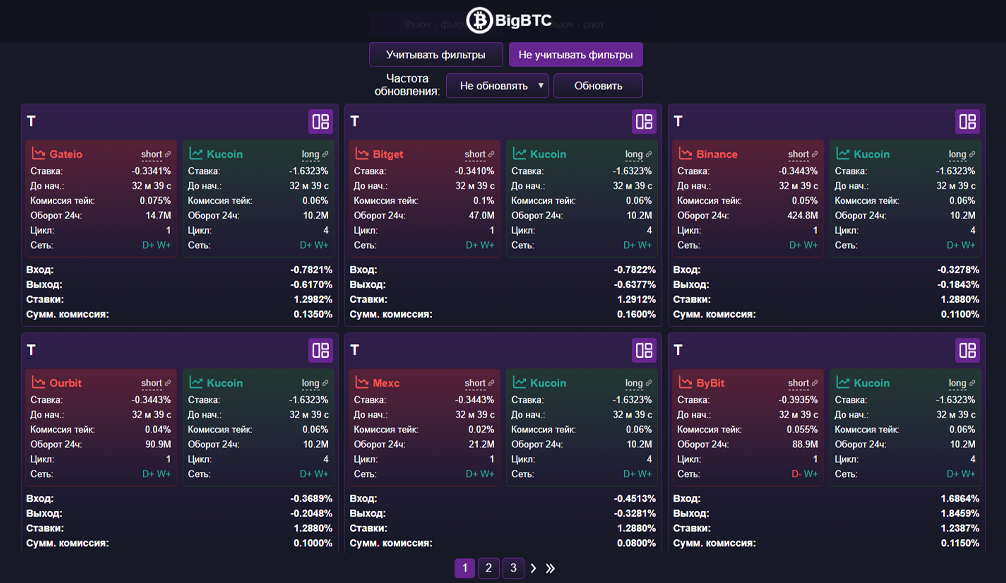
This type of arbitrage is performed exclusively using perpetual futures on different exchanges.
Here, the trader simultaneously opens short and long positions on two different exchanges for the same coin.
The positions are opened for the same amount of the coin and hedge each other.
Profit can come from funding rates, price spreads, listings, and delistings.
Examples of futures-to-futures arbitrage opportunities from https://t.me/BigBTC_funding_bot :
Futures-to-spot arbitrage Copy link
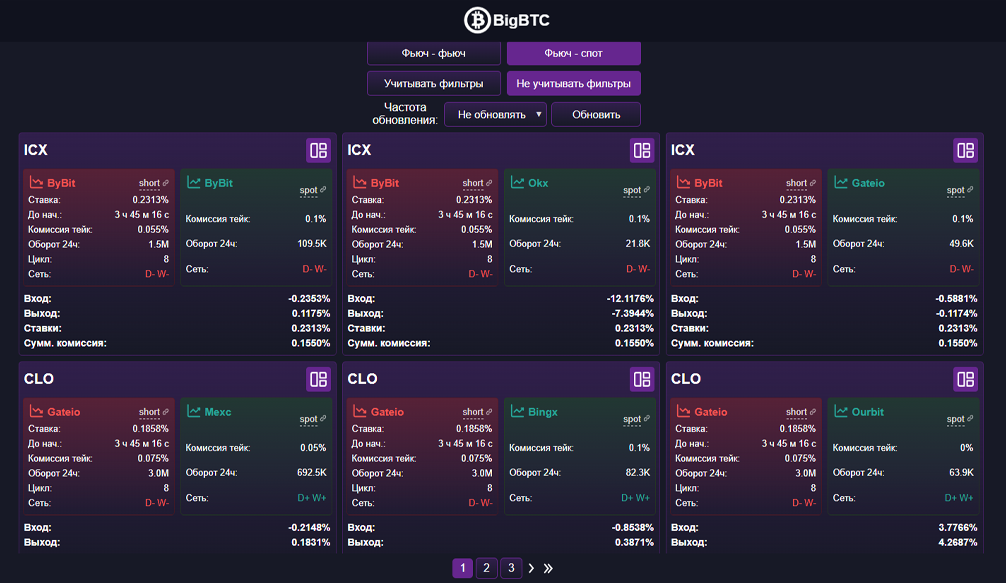
In futures-to-spot arbitrage, we also open a short position in the futures market on one exchange, but instead of opening a long futures position on the other exchange, we buy the coin on the spot market.
Profit can also come from funding rates, price spreads, listings, and delistings.
Futures-to-spot arbitrage can be performed:
1 Between different exchanges
- when we open a short position on one exchange and buy the coin on the spot market on another exchange
2 Within a single exchange
- when we open a short position and buy the coin on the spot market across different markets (futures and spot) within the same exchange
In futures-to-spot arbitrage, we always open a short position on the futures market.
Why?
Let's take a look: we buy the coin on the spot market.
- If the coin rises, we make a profit on the spot market. At the same time, we lose on the short position.
- If the coin's price falls, we lose on the spot market, but the short position becomes profitable.
In both cases, the overall balance is preserved.
If we open a long position instead of a short position against the spot position, then if the coin falls, we lose on both the spot and futures positions. This can no longer be considered a proper arbitrage strategy.
Our scanner bot https://t.me/BigBTC_funding_bot sends only short-to-spot opportunities for the futures-to-spot direction, so you won't make this mistake.
Arbitrage with exchange services listed on BestChange Copy link
An exchange service aggregator is a platform that collects information about multiple exchange services in one place and allows users to compare their exchange rates and terms.
There are several exchange monitoring platforms, such as BestChange, Exnode, and other services.
For our strategy, we use BestChange. Why?
- It is one of the best-known and longest-running exchange monitoring platforms. BestChange has been operating since 2007 and, at the time of writing, lists more than 600 exchange services in its monitoring system. The service collects information about exchange rates and reserves and regularly updates this data.
- BestChange states that every exchange service undergoes verification before being added to active monitoring, and the administration continues to monitor its operation after it has been added.
- The aggregator has an important feature - a reputation system. Users can leave reviews about their experience with exchange services. If an exchange service has problems with its customers, this becomes visible to other users of the monitoring platform.
- BestChange states that if problems arise with an exchange service, the administration can take action, including temporarily removing the service from the rankings until the issue is resolved.
The aggregator provides targeted traffic to exchange services, so maintaining a good reputation and meeting the monitoring requirements is very important for an exchange service.
We strongly recommend against working with unknown exchange services that are not listed on a trusted aggregator.
How arbitrage between an exchange and an exchange service works
The main idea behind arbitrage between an exchange and an exchange service is very simple: we compare two independent markets.
On one side is a cryptocurrency exchange, where the market price is determined by buy and sell orders.
On the other side is an exchange service that sets its own exchange rate.
If the terms on these two markets temporarily differ enough, a spread arises.
Bank cards, bank accounts, and cash are not used in this type of arbitrage. All operations take place within the cryptocurrency infrastructure. Every arbitrage opportunity starts and ends with the USDT stablecoin, and all profit accumulates on the exchange in USDT.
An example of an arbitrage opportunity from the scanner https://t.me/cryptocurrency_arbitrage_bot looks like this:
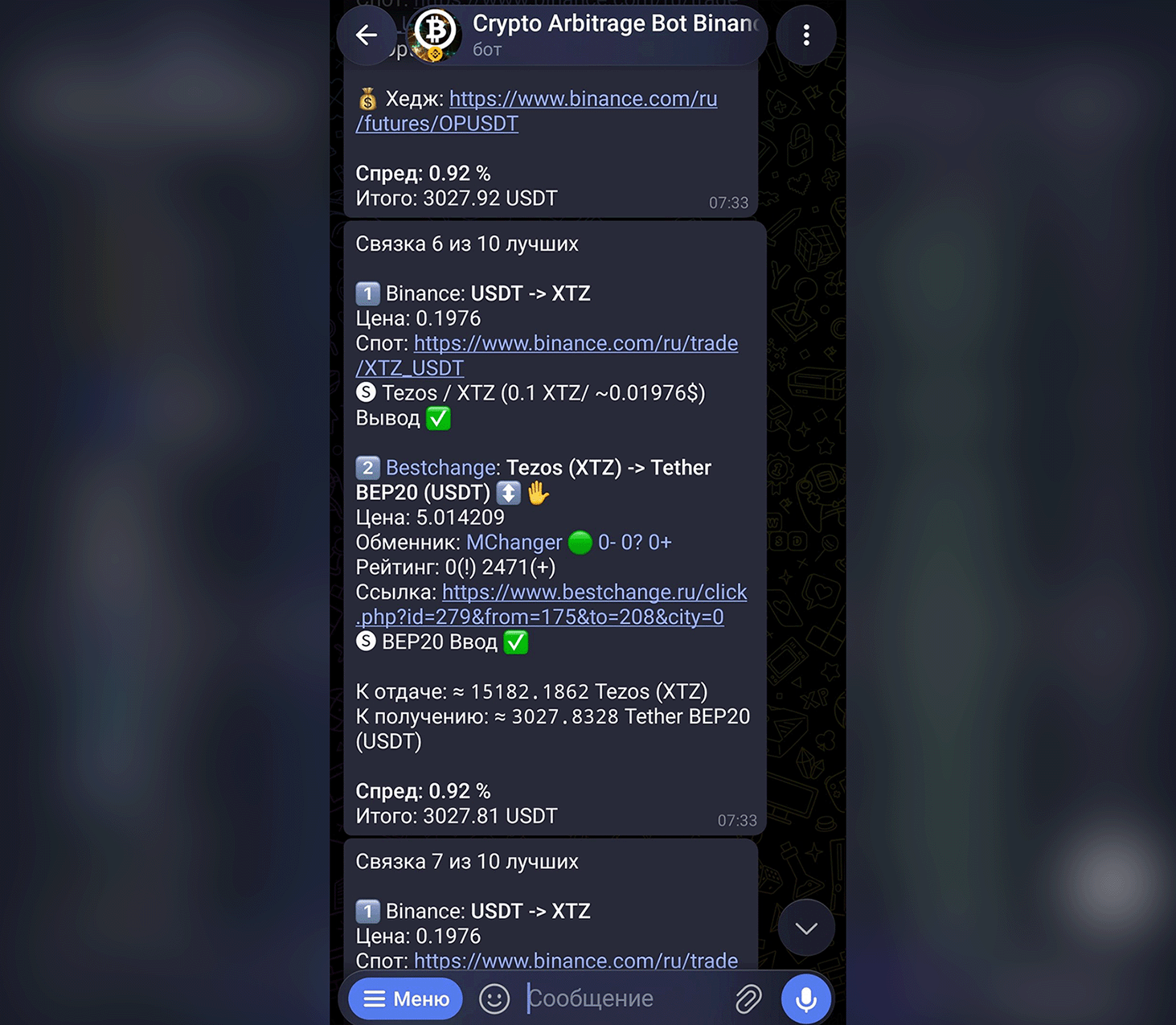
In this example:
- On Binance, we buy XTZ for USDT
- We send XTZ to a specific exchange service listed on BestChange
- The exchange service sends USDT back to our Binance account
- Our profit is 0.92%